
Originally Published October 22. 2022
Updated February 15, 2026
Although the FBI has categorized Romance and Dating Scams under “common scams and crimes,” romance scams can be devastating, causing lasting psychological, material, and emotional damage to victims.
It is not uncommon for romance and dating scams to ruin lives and bury futures.
The perpetrators of romance scams usually assume a fake online identity and use social media networks and dating sites to contact their would-be victims.
Having gained the affection and trust of the victim, the romance scammer uses the illusion of a romantic relationship to manipulate victims into paying them money.
Romance scams can feature various levels of sophistication.
Some of the clumsier romance scammers do not even bother using a fake identity.
While they may be easier to identify and prosecute, they still inflict enduring damage on the victims.
The most dangerous scammers usually hide behind a fake identity, and often continue manipulating victims until they have extracted as much money as possible, often putting them into debt.
They will propose marriage or meeting in person, they will fake various emergencies, and they will forge fake documents.
The most voracious romance scammers will even drive a wedge between their victims and the loved ones of the scammed, upending their lives in every possible way.
Romance scams remain highly lucrative for criminals, and that motivates them to be highly creative.
Romance scams often target individuals seeking connection, companionship, or support; things most people naturally desire.
Many choose to suffer in silence, embarrassed to report their losses to the authorities or talk about them to friends/family.
According to the FTC, in 2023 alone, victims lost more than $1.14 billion to romance scams, with the median losses per person being $2,000.
According to the same FTC report, in 2023, more than 64,003 consumers filed reports with the Commission in the US alone.
The global size of the romance scam “market” is difficult to ascertain.
To some, it may come as a surprise that most victims of romance scams are women.
Romance scammers are not picky, however.
They will target anyone from any walk of life as long as they suspect the victim may have savings or access to money that they can steal.
To help you recognize a romance scam, we take a closer look at the lies scammers use and some of the ways they tend to operate.
If you want to save yourself heartaches, embarrassment, and money, observing a simple rule can serve you extremely well.
If someone you have never met in person asks you for money, that is a major red flag and should be treated with extreme caution.
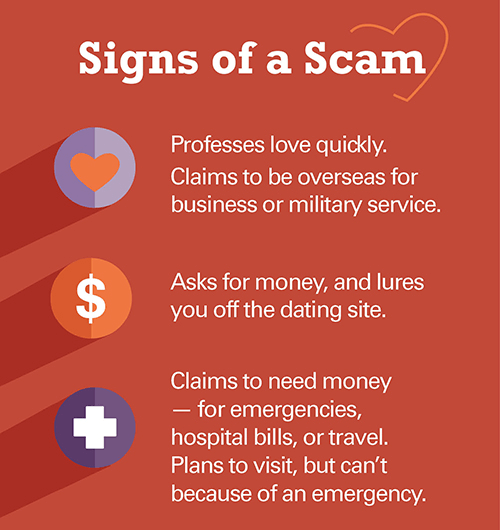
Lies Romance Scammers Tell
In almost all cases, the name used by the scammer is fictitious.
His/her identity is a fake one, forged using pictures and video material lifted from other people’s websites or social media profiles or obtained through cybercrime, such as database hacks.
A romance scammer will usually claim to reside in a country different from yours, preferably on a different continent.
Scammers may also claim that they are traveling abroad or working there.
Do not underestimate the patience and persistence of romance scammers.
Some of them will sink months or even years into getting you acquainted with their fake persona and building up trust.
Common romance scam angles may claim that the perpetrator is working on an offshore oil rig, at a remote military installation, or with an international charity.
Scammers may also pretend to work in construction, on a project in a different country.
The “remoteness” angle makes it more plausible for them to avoid meeting in person and later ask for payments to cover various fictitious costs.
Having established rapport and trust, scammers move on to the second phase of their scheme.
They come up with a make-believe emergency, and they:
- Ask their victims to loan them money to cover travel expenses/to make it possible for them to return home
- Request money for a plane ticket
- Fake a medical emergency and request money to cover the costs of non-existing surgeries, etc
- Pretend to have gambling problems and ask for money to pay off debts
- Pretend to want to visit and request money for travel documents and visa fees
- May request money to cover customs fees and recover various fictitious items of purportedly great value
How Romance Scammers Want You to Pay
Scammers prefer payment methods that are difficult or impossible to track and reverse.
Thus, they will likely ask you to pay through a wire transfer, cryptocurrency, Zelle, Cash App, Venmo, gift cards/reloadable cards, MoneyGram, Western Union, or an online remittance provider, such as Remitly.
If your new online “crush” mentions cryptocurrencies such as Bitcoin, this is a red flag.
Cryptocurrencies can be complex to trace and are often difficult to reverse once sent. Specialized investigative firms, like CNC Intelligence, may assist victims and law enforcement by conducting blockchain analysis and tracing the movement of digital assets, but prevention remains the most effective protection.
A Few Facts about Romance Scams According to Special Agent Christine Beining of the FBI
For more information, please see the video of Special Agent Christine Beining:
- Historically, many reported victims were women over 40. However, recent data shows that romance-related cryptocurrency scams increasingly target men and women across all age groups.
- Romance scammers pore through social media/networking sites and choose their victims based on the information they post on their profiles.
- Skilled cybercriminals are very good at using the information you provide voluntarily through your social media profile to manipulate you.
- Although sometimes they can be extremely patient, most romance scammers aim to move quickly, telling their victims what they want to hear, proposing marriage, etc.
- Scammers actively seek out people who are divorced or widowed. They see this demographic as emotionally more vulnerable, and they aim to cash in on this perceived “weakness.”
- Perpetrators may promise that they will repay the victims as soon as they get out of the purported fix, which they say they are. This way, they reduce the “stakes” of the transaction, making the victim believe it is just a temporary loan.
- Behind many of the scams, there are criminal organizations and networks. Once victims accept the proposal and send money, they land on a “sucker list.” The criminals then share their victim’s identities among themselves, allowing others to target those already “burnt.”
- Doing some research on the scammer’s profile will often yield enough relevant information to allow the would-be victim to recognize the scam and avoid it.
- Unfortunately, law enforcement has seen victims fall for romance scams repeatedly.
- Law enforcement encourages victims to share their ordeals with others to prevent other potential victims from falling for a romance scam.
- Sometimes, cybercriminals may request bank account details from their victims with the stated intent to deposit money. If they manage to get the information, they use the bank account for other cyber theft and fraud schemes.
- In recent years, many romance scams have evolved into what law enforcement calls “pig butchering” schemes. In these cases, scammers build long-term trust and then introduce victims to fraudulent cryptocurrency investment platforms. Victims may initially see small “profits,” which encourages them to invest larger amounts before the platform disappears.
What Can You Do to Avoid Romance and Dating Scams?
While scammers can be sophisticated, understanding common red flags can significantly reduce your risk.
Never send money to someone you have only interacted with online.
- Be very careful what you post on your social media profiles. This is the foremost source of information for scammers. You would be surprised to learn how well scammers can understand and emotionally engage you through this information.
- Run a reverse search on the person’s photos. Such searches reveal other instances of the picture available online. If you notice that your “crush” is already present online under three different names, you will know that you are dealing with a scam. Less sophisticated romance scammers always steal their photos online, so reverse image search can indeed help you avert disaster.
- If a person asks you to leave the social media or dating site and communicate directly through email or a messaging app, consider it a red flag.
- Do not be afraid to question everything the individual tells you.
- Never share inappropriate pictures of yourself. Scammers may use them to blackmail you. Never share any financial information in any shape or form.
- Scammers may attempt to distance you from your loved ones. Isolated and without a second opinion acting as the voice of reason, you will be more vulnerable. Consider such attempts a giant red flag.
- If you fail to set up a personal meeting with the person for a few months, you should see that as a red flag as well, especially if he/she comes up with excuses to avoid meeting.
- Never send money to a person with whom you have only communicated online or through the phone.
- Stop communicating with the person you suspect of being a scammer.
- Pay attention to how your family/friends react to your online “relationship.” The more people know about it, the more likely it is someone will open your eyes to the scam.
- Run a search on the job your online “crush” claims to have, and see if you run into instances of people being scammed through such claims.
- Never travel alone to meet someone you meet online.
- If you visit a foreign country to meet a romantic interest, contact your embassy before your visit.
- Read all travel advisories associated with a foreign country before your visit.
What To Do If You Have Been Targeted
-
Stop all communication
-
Preserve messages and transaction records
-
Report the crime to your local police and to the FBI via IC3 (ic3.gov)
-
If you provided personal identifiable information, report identity theft at identitytheft.gov and submit a report to the FTC (reportfraud.ftc.gov)
-
Contact your bank or exchange immediately
The toxicity of romance scams often leads not only to financial fraud but also results in heartbreak and can destroy meaningful relationships.
The first step of your healing process is to reengage with your family and friends and build back your support structure.
The emotional recovery from romance and dating scams can take time, and if you need to speak with someone, do not hesitate to get professional help from a licensed therapist or counselor.
Any financial loss should be considered secondary to your emotional and mental well-being.
In order to consider any options to recover your funds, you should first make sure to be in an emotional state to make good decisions and have the support of your loved ones to lean on.
We offer complimentary consultations to determine if our Asset Tracing, Recovery Assistance, and Intelligence Services are suitable for your case.
When you comment, your name, comment, and timestamp will be public. We also store this data, which may be used for research or content creation in accordance with our Privacy Policy. By commenting, you consent to these terms.
I was scam from one girl from Tunisia i was there and she try to clean my brain i was spending there 3000 plus gifts can help someone?
Thanks!
Sure. Please go ahead and schedule a free consultation with us to find out if and how we can help you: https://cncintel.com/consultation/.
Dear Dorin. We understand that this must be a tough situation for you. Tracing the usage of gift cards is a challenging task due to the nature of their usage and the anonymity they provide. Even though our investigative team is highly experienced, tracing gift cards isn’t usually feasible.
Nevertheless, we encourage you to report this incident to your local law enforcement and also to the platform where you met this individual, as they might be able to take necessary actions to prevent such instances in the future.
Please, also consider talking to someone you trust about your experience. As our article points out, these scams can be emotionally devastating, and it can help to share what you’re going through with supportive people in your life.
I am glad I read this. I was scammed out of a little over 15k. They were trying to distance myself from my family and friends like it was stated above. I never paid attention to that nagging voice that they were a scammer. They sent a picture and I knew I was scammed. The majority was bitcoin, but some of it was gift cards. I accepted the lose, which still hurts, bit I am glad I still have my family
Dear Dawn Granberry,
We are sincerely sorry to hear about your experience. Romance scams are unfortunately all too common and can be devastating financially and emotionally. Your strength and willingness to share your story are commendable and will surely help others avoid falling into a similar trap.
At CNC Intelligence, we specialize in assisting victims of online scams, and while we understand you’ve accepted your loss, we might be able to help you trace the Bitcoin transactions and possibly recover some of your funds. The process can be complex, but we have a team of experts who work closely with law enforcement and legal professionals.
If you’re interested, please feel free to contact us directly through our website or via email at [email protected]. We’re here to support you, and even if recovery isn’t possible, we can provide guidance to help prevent future scams.
Remember, it’s never a sign of weakness to ask for help or to heed that nagging voice when something doesn’t feel right. Stay strong and continue to share your story to help raise awareness about these scams.
Help, I feel victim to a romance scammer for thousands of dollars, he is won’t leave me alone thought i blocked him multiple times. I got a fake pay check from him and foolishly deposited it, only to have it reversed once i withdrew money. He claims he will help pay for the damages when he arrives, but i know he won’t and its all been for nothing. I feel so stupid fall for what should have set off many flags..
We’re sorry to hear that you’ve experienced this. We commend you for recognizing the situation for what it is. Here’s a step-by-step course of action you should consider:
1. Report the scam to your local police. While they may not always be able to recover the lost funds, they will make a record of the incident, which could help in future investigations.
2. Inform your bank about the scam. If you’ve deposited a fake check, they need to know about it. The bank can provide guidance on how to protect your account or suggest opening a new one.
3. Keep records of all your communications with the scammer. This includes text messages, emails, and any other evidence you have. This will be useful when reporting the incident to the police and other relevant agencies.
4. While it sounds like you’ve already tried this, ensure you cease all forms of communication with the scammer. If they continue to try to contact you, do not respond.
5. Report the scam to the Federal Trade Commission (FTC) through their website in the USA, the Canadian Anti-Fraud Centre, UK Action Fraud, or any relevant agency or organization that handles fraud and cybercrime complaints in your country.
6. Change the passwords for all your accounts, especially if you’ve shared any personal details with the scammer.
7. These scams can be emotionally distressing. Consider seeking support from close friends or family or even professional counseling. Some communities have support groups specifically for victims of scams or cybercrimes.
Remember, scammers are professionals who have perfected their craft. They prey on kind-hearted and trusting individuals. It’s easy to look back with hindsight and see the red flags, but in the moment, many people fall victim to these scams.
Please take action and protect yourself. Remember that you’re not alone in this, and resources and people are willing to help and support you.
I need a consult I have been in a romance scam with crypto and a bank transfer asap
Dear Skyler,
Thank you for reaching out to CNC Intelligence. We received your inquiry regarding the romance scam involving cryptocurrency and a bank transfer, and we’re here to assist you.
However, we noticed that we don’t have your contact number to give you a call back. To ensure we can provide you with the best possible assistance, could you please schedule a consultation with us? You can do so by visiting our website at https://cncintel.com/consultation/. This will allow us to understand your situation in more detail and discuss how we can help you effectively.
We appreciate your trust in CNC Intelligence and look forward to supporting you through this.
Best regards,
CNC Intelligence Team
i need help in getting my scammed money back
Thank you for reaching out, Allen. I’m sorry to hear about your situation. Please schedule a free consultation through our official page https://cncintel.com/consultation/ so our investigators can review your case in detail and guide you on the next steps.