
Originally Published October 22, 2022
Updated September 15, 2026
Romance and dating scams can cause serious financial and emotional harm. In these schemes, a criminal typically creates a false or misleading online identity, builds trust or an emotional connection, and eventually uses that relationship to ask for money, cryptocurrency, financial information, or other assistance.
Romance scams can begin on dating apps, social media platforms, messaging services, or even through an unsolicited text message. Increasingly, scammers also combine romantic or personal relationships with fraudulent cryptocurrency investment opportunities.
The people targeted by these schemes come from many different backgrounds and age groups. Scammers often spend weeks or months developing trust before introducing a financial request, investment opportunity, emergency, or other reason for the victim to send money.
According to the Federal Trade Commission (FTC), reported losses associated with romance scams increased by 22% in 2025. The FTC also reported that nearly 60% of people who reported losing money to a romance scam in 2025 said the scam began on social media.
Romance scammers may be individuals, but some schemes are connected with larger criminal networks. The relationship may be entirely fabricated, or the person communicating with the victim may be working from a prepared script designed to build trust and eventually obtain money or financial information.
A particularly important warning sign is simple:
If someone you have never met in person asks you to send money, cryptocurrency, gift cards, or other assets, treat the request with extreme caution.
How Romance Scams Work
Romance scammers usually begin by creating an identity they believe will appeal to the person they are targeting.
The identity may use stolen, altered, or AI-generated photographs, videos, profile information, or other material to appear legitimate. Advances in artificial intelligence and deepfake technology can also make fabricated identities more convincing than they were in the past.
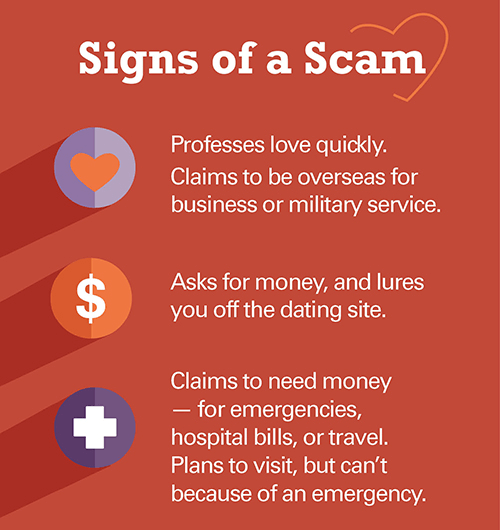
Scammers may claim to live or work far away, making it difficult to meet them in person. Common stories include working:
- On an offshore oil rig
- At a military installation
- On an international construction project
- For an international organization or charity
- On a ship or in another remote location
- Temporarily in another country for business
The distance provides a convenient explanation for why the person cannot meet in person while also creating opportunities for supposed emergencies involving travel, medical expenses, customs fees, legal problems, or other financial needs.
Building Trust Before Asking for Money
Some romance scammers move quickly. Others may spend months developing a convincing relationship before making a financial request.
They may communicate frequently, express strong romantic feelings, discuss marriage, make plans to meet, or create the impression that the relationship has become serious.
Once sufficient trust has been established, the story often changes.
The scammer may claim to:
- Need money for travel expenses or an airline ticket
- Have a medical emergency
- Need help paying an unexpected legal or business expense
- Need money for a visa or travel document
- Need to pay customs fees for a valuable package or shipment
- Have temporary difficulty accessing their own money
- Need help with a business transaction
- Want to introduce the victim to an investment opportunity
They may promise that any money sent is only a temporary loan and will be repaid shortly.
Repeated emergencies or new reasons why additional money is required are significant warning signs.
How Romance Scammers Want You to Pay
Scammers often prefer payment methods that are difficult to reverse and may make the return of funds more difficult.
They may request payment through:
- Cryptocurrency
- Wire transfers
- Zelle
- Cash App
- Venmo
- Gift cards or reloadable cards
- MoneyGram
- Western Union
- Online remittance services
The payment method alone does not prove that a relationship is fraudulent. The surrounding circumstances matter.
However, if someone you met online begins asking you for money or instructing you how to transfer assets, stop and independently evaluate the situation before sending anything.
Romance Scams and Cryptocurrency
Cryptocurrency has become an important component of many online confidence and romance scams.
If an online romantic interest encourages you to purchase or send cryptocurrency, or introduces you to a cryptocurrency investment opportunity, treat it as a major warning sign.
The FBI warns that cryptocurrency investment fraud frequently begins with an online relationship. The relationship may appear romantic, friendly, or professional before the scammer introduces what appears to be a profitable investment opportunity.
The victim may be directed to a fraudulent cryptocurrency investment website or application that displays fictitious:
- Account balances
- Investment profits
- Trading activity
- Returns
- Withdrawals
In some cases, the platform allows a small withdrawal early in the scheme to increase the victim’s confidence.
The scammer then encourages increasingly large deposits. When the victim eventually attempts to withdraw substantial funds, the platform may demand additional payments for supposed taxes, commissions, liquidity requirements, verification fees, or other charges.
The FBI categorizes these schemes as cryptocurrency investment fraud. They are also commonly described as pig-butchering scams.
Do not continue sending money simply because a platform claims another payment is necessary before you can withdraw your funds.
Can Cryptocurrency Sent in a Romance Scam Be Traced?
Many cryptocurrency transactions are recorded on public blockchains and can be analyzed after they occur.
Depending on the blockchain, asset, and transaction path, cryptocurrency investigators may be able to trace transaction flows and identify relevant wallets, cryptocurrency exchanges, or other Virtual Asset Service Providers (VASPs).
A simplified transaction path might look like:
Victim wallet → scam wallet → intermediary wallets → cryptocurrency exchange
However, a wallet address does not automatically reveal the real-world identity of the person controlling it.
If cryptocurrency reaches an identifiable exchange or other service provider, that organization may possess account or transaction records that are not publicly visible on the blockchain.
Cryptocurrency tracing and recovery are separate processes. Identifying where cryptocurrency moved does not guarantee that the assets can ultimately be frozen, seized, or returned.
CNC Intelligence provides cryptocurrency tracing, cyber intelligence, and investigative reporting. CNC Intelligence does not independently freeze, seize, hold, release, or return cryptocurrency and cannot guarantee recovery.
Common Warning Signs of a Romance Scam
No single warning sign proves that someone is a scammer. However, multiple warning signs should be taken seriously.
Be particularly cautious when someone you met online:
- Develops unusually strong romantic feelings very quickly
- Claims to live or work far away
- Repeatedly avoids meeting in person
- Frequently has technical problems when asked to video chat
- Asks to move conversations away from the original dating or social platform
- Asks you to keep the relationship or financial activity secret
- Tries to isolate you from friends or family
- Requests money for an emergency
- Asks you to receive or transfer money on their behalf
- Requests your bank account information
- Encourages you to purchase cryptocurrency
- Introduces you to a cryptocurrency or investment platform
- Claims to have an investment method with unusually high or guaranteed returns
- Pressures you to invest quickly
- Becomes hostile or manipulative when you question financial requests
The FBI also warns that scammers may use deepfake technology or even real people on phone or video calls to make a fraudulent identity appear more credible.
Common Romance Scam Tactics
Romance and confidence scammers continuously adapt their methods, but several patterns appear repeatedly.
- Moving communication off-platform: The scammer may quickly suggest moving from a dating site or social network to WhatsApp, Telegram, text messages, or email.
- Creating distance: Claims of military service, construction work, offshore employment, international travel, or other remote assignments can explain why the scammer cannot meet.
- Building emotional dependence: Frequent messages, expressions of affection, and discussions of a future together can create a strong sense of trust.
- Creating an emergency: Once trust is established, a medical, legal, travel, business, or family emergency suddenly requires money.
- Introducing investments: The scammer may casually discuss investment success before offering to teach the victim how to invest.
- Creating isolation: Scammers may discourage victims from discussing the relationship or investment with family members, financial advisors, or friends.
- Requesting financial information: Some scammers request bank account information under the pretense of sending money. Financial accounts obtained this way may instead be used for fraudulent transactions or money movement.
- Requesting additional payments: After money has already been sent, the scammer may invent new reasons why additional funds are necessary.
How to Avoid Romance and Dating Scams
Romance scammers can be sophisticated, but several precautions can substantially reduce your risk.
Never send money, cryptocurrency, or valuable assets to someone solely because of an online romantic relationship.
- Limit personal information on social media. Scammers can use information about your family, interests, employment, travel, relationships, and finances to create a convincing approach.
- Use reverse image search. Search the person’s profile images online. If the same photograph appears under different names or identities, that is a significant warning sign.
- Research their story. Search for the person’s claimed job, circumstances, or financial problem together with terms such as “scam” or “fraud.”
- Question requests to leave the original platform. Moving quickly to WhatsApp, Telegram, email, or another messaging platform may be part of a scammer’s strategy.
- Do not share sensitive financial information. Avoid providing banking credentials, passwords, authentication codes, seed phrases, private keys, or other sensitive information.
- Be cautious with intimate images. Images or videos may later be used for blackmail or sextortion.
- Talk to someone you trust. A friend or family member who is not emotionally involved may notice inconsistencies or warning signs that are difficult to recognize from inside the relationship.
- Be cautious when someone repeatedly avoids meeting. Distance alone does not prove fraud, but repeated excuses for avoiding an in-person meeting should be evaluated carefully.
- Do not let an online relationship direct your investment decisions. Independently research investments and financial providers before sending money.
- Be wary of guaranteed investment returns. Legitimate investments involve risk.
- Use extra caution before international travel. If you plan to travel to meet someone known only online, tell trusted family or friends where you are going and review relevant government travel advisories.
What to Do If You Have Been Targeted by a Romance Scam
If you believe you are dealing with a romance scam, take action as soon as reasonably possible.
-
Stop sending additional money or cryptocurrency.
Do not pay further emergency expenses, taxes, withdrawal fees, investment fees, or other charges requested by the person or platform.
-
Preserve your communications.
Save emails, text messages, WhatsApp or Telegram conversations, social-media profiles, photographs, usernames, phone numbers, websites, and other communications.
-
Preserve transaction records.
Keep bank records, wire information, payment receipts, cryptocurrency transaction hashes (TXIDs), wallet addresses, exchange records, screenshots, and account information.
-
Contact your bank, payment provider, or cryptocurrency exchange.
Tell the provider that the transaction may be connected with fraud and ask what options or reporting procedures are available.
-
Report the account to the dating or social-media platform.
The platform may be able to investigate the account and help prevent the same identity from targeting additional users.
-
Report the fraud to law enforcement.
In the United States, reports can be submitted to the FBI’s Internet Crime Complaint Center at IC3.gov.
-
Report the incident to the FTC.
Fraud can be reported at ReportFraud.ftc.gov.
-
Take action if personal information was compromised.
If personally identifying information was exposed, consider reviewing the resources available at IdentityTheft.gov.
If Cryptocurrency Was Involved
If you sent cryptocurrency as part of a romance or investment scam, preserve:
- Transaction hashes (TXIDs)
- Sending wallet addresses
- Receiving wallet addresses
- Cryptocurrency type and blockchain network
- Exchange deposit or withdrawal records
- Transaction amounts and dates
- Screenshots of the investment platform
- URLs and domain names
- Communications explaining where to send the cryptocurrency
This information can help establish the starting point for a cryptocurrency tracing investigation.
Blockchain tracing may help document where the cryptocurrency moved and identify relevant wallets, exchanges, or other service providers where possible.
Learn more about CNC Intelligence’s cryptocurrency tracing and investigation services.
Beware of Recovery Scams After a Romance Scam
People who have already lost money to a romance or cryptocurrency scam may be targeted again.
A second scammer may claim to be:
- A cryptocurrency recovery company
- A private investigator
- An attorney
- A government official
- A law-enforcement officer
- A cryptocurrency exchange representative
- A cybersecurity specialist
They may claim that your money or cryptocurrency has already been found, frozen, seized, or recovered and that you only need to make another payment before it can be released.
Be extremely cautious of unsolicited recovery offers, guaranteed recovery claims, or demands for taxes, release fees, wallet activation fees, insurance payments, or additional cryptocurrency.
The FBI specifically warns victims of cryptocurrency investment fraud not to pay services claiming they can recover lost funds, because these offers are often scams themselves.
Read more about Bitcoin recovery services and recovery scams.
Romance Scams Can Cause More Than Financial Harm
Romance scams are designed to exploit trust. Discovering that a relationship was fabricated can cause emotional harm in addition to financial loss.
There is no reason to allow embarrassment or shame to prevent you from reporting what happened. These scams are deliberately designed to manipulate people, and sophisticated criminal networks may use extensive preparation, social engineering, false documents, fabricated identities, and long-term communication to gain trust.
Consider speaking with trusted family members or friends and, if appropriate, a qualified mental-health professional for additional support.
Emotional support and practical action do not have to happen separately. At the same time, preserve your evidence, report the incident, secure affected accounts, and contact relevant financial institutions or cryptocurrency exchanges as soon as reasonably possible.
How CNC Intelligence Can Help With a Romance Scam Investigation
CNC Intelligence is a private investigation and cyber intelligence firm. Where cryptocurrency or other digital evidence is involved in a romance scam, our investigative work may include:
- Reviewing cryptocurrency transaction information
- Tracing relevant blockchain transaction flows
- Analyzing wallet activity
- Identifying known exchanges or other service providers where possible
- Conducting lawful Open Source Intelligence (OSINT) and cyber intelligence research
- Reviewing websites, domains, online profiles, and related digital information
- Developing investigative leads
- Preparing detailed investigative reports
- Providing technical support concerning investigative findings
Our findings may assist law enforcement, attorneys, financial institutions, or other authorized parties in evaluating appropriate investigative or legal next steps.
CNC Intelligence does not independently freeze, seize, hold, release, or return cryptocurrency or other assets and cannot guarantee recovery.
We offer complimentary consultations to determine whether our Asset Tracing and Intelligence Services may be appropriate for your case.
When you comment, your name, comment, and timestamp will be public. We also store this data, which may be used for research or content creation in accordance with our Privacy Policy. By commenting, you consent to these terms.
I was scam from one girl from Tunisia i was there and she try to clean my brain i was spending there 3000 plus gifts can help someone?
Thanks!
Sure. Please go ahead and schedule a free consultation with us to find out if and how we can help you: https://cncintel.com/consultation/.
Dear Dorin. We understand that this must be a tough situation for you. Tracing the usage of gift cards is a challenging task due to the nature of their usage and the anonymity they provide. Even though our investigative team is highly experienced, tracing gift cards isn’t usually feasible.
Nevertheless, we encourage you to report this incident to your local law enforcement and also to the platform where you met this individual, as they might be able to take necessary actions to prevent such instances in the future.
Please, also consider talking to someone you trust about your experience. As our article points out, these scams can be emotionally devastating, and it can help to share what you’re going through with supportive people in your life.
I am glad I read this. I was scammed out of a little over 15k. They were trying to distance myself from my family and friends like it was stated above. I never paid attention to that nagging voice that they were a scammer. They sent a picture and I knew I was scammed. The majority was bitcoin, but some of it was gift cards. I accepted the lose, which still hurts, bit I am glad I still have my family
Dear Dawn Granberry,
We are sincerely sorry to hear about your experience. Romance scams are unfortunately all too common and can be devastating financially and emotionally. Your strength and willingness to share your story are commendable and will surely help others avoid falling into a similar trap.
At CNC Intelligence, we specialize in assisting victims of online scams, and while we understand you’ve accepted your loss, we might be able to help you trace the Bitcoin transactions and possibly recover some of your funds. The process can be complex, but we have a team of experts who work closely with law enforcement and legal professionals.
If you’re interested, please feel free to contact us directly through our website or via email at [email protected]. We’re here to support you, and even if recovery isn’t possible, we can provide guidance to help prevent future scams.
Remember, it’s never a sign of weakness to ask for help or to heed that nagging voice when something doesn’t feel right. Stay strong and continue to share your story to help raise awareness about these scams.
Help, I feel victim to a romance scammer for thousands of dollars, he is won’t leave me alone thought i blocked him multiple times. I got a fake pay check from him and foolishly deposited it, only to have it reversed once i withdrew money. He claims he will help pay for the damages when he arrives, but i know he won’t and its all been for nothing. I feel so stupid fall for what should have set off many flags..
We’re sorry to hear that you’ve experienced this. We commend you for recognizing the situation for what it is. Here’s a step-by-step course of action you should consider:
1. Report the scam to your local police. While they may not always be able to recover the lost funds, they will make a record of the incident, which could help in future investigations.
2. Inform your bank about the scam. If you’ve deposited a fake check, they need to know about it. The bank can provide guidance on how to protect your account or suggest opening a new one.
3. Keep records of all your communications with the scammer. This includes text messages, emails, and any other evidence you have. This will be useful when reporting the incident to the police and other relevant agencies.
4. While it sounds like you’ve already tried this, ensure you cease all forms of communication with the scammer. If they continue to try to contact you, do not respond.
5. Report the scam to the Federal Trade Commission (FTC) through their website in the USA, the Canadian Anti-Fraud Centre, UK Action Fraud, or any relevant agency or organization that handles fraud and cybercrime complaints in your country.
6. Change the passwords for all your accounts, especially if you’ve shared any personal details with the scammer.
7. These scams can be emotionally distressing. Consider seeking support from close friends or family or even professional counseling. Some communities have support groups specifically for victims of scams or cybercrimes.
Remember, scammers are professionals who have perfected their craft. They prey on kind-hearted and trusting individuals. It’s easy to look back with hindsight and see the red flags, but in the moment, many people fall victim to these scams.
Please take action and protect yourself. Remember that you’re not alone in this, and resources and people are willing to help and support you.
I need a consult I have been in a romance scam with crypto and a bank transfer asap
Dear Skyler,
Thank you for reaching out to CNC Intelligence. We received your inquiry regarding the romance scam involving cryptocurrency and a bank transfer, and we’re here to assist you.
However, we noticed that we don’t have your contact number to give you a call back. To ensure we can provide you with the best possible assistance, could you please schedule a consultation with us? You can do so by visiting our website at https://cncintel.com/consultation/. This will allow us to understand your situation in more detail and discuss how we can help you effectively.
We appreciate your trust in CNC Intelligence and look forward to supporting you through this.
Best regards,
CNC Intelligence Team
i need help in getting my scammed money back
Thank you for reaching out, Allen. I’m sorry to hear about your situation. Please schedule a free consultation through our official page https://cncintel.com/consultation/ so our investigators can review your case in detail and guide you on the next steps.