
Based on CNC Intelligence’s analysis of 3,141 rental listings collected across 16 U.S. cities in August 2026.
Report by CNC Intelligence. Listings collected August 2026.
Americans have reported losing $65 million to rental scams since 2020, according to the Federal Trade Commission. Fake listings have long been common on platforms like Facebook and Craigslist. We wanted to know how common they have become on TikTok.
The FTC also reports that people aged 18 to 29 are three times more likely than other adults to report losing money to a rental scam – and TikTok is exactly where to find this age group.
We collected 3,141 rental listings across 16 different U.S. cities. 44% had strong warning signs of being a scam, and another 24% had highly suspicious flags. Together, that means more than two-thirds of the listings in our study carried medium or strong scam warning signs.
What we did
We looked at 16 popular rental cities across the U.S. and searched for things like “apartments for rent [city]”, keeping any post advertising a specific property.
We compared each listing’s asking rent against what the property or its area actually rents for, and checked details like the bedroom count and phone number. We flagged anything that didn’t add up.
Full detail is in the methodology at the end.
What this report does and does not claim
This report describes a sample of TikTok listings we collected in August 2026. It does not describe every rental listing on TikTok, and it is not a statement about any individual account, poster, property owner or property.
“Warning signs” means a listing carries characteristics that our checks could not reconcile against public records or local rent data. It does not mean fraud has occurred.
Key findings
-
68% of the rental ads we checked on TikTok carried warning signs of being a scam – an asking price far below what the property actually rents for, a home that’s listed for sale rather than rent, or a phone number being used by unrelated accounts across several different cities.
-
Of the 2,791 listings we could price-check, 2,216 came in at least 25% below market rate, and half of those at less than half the going rate.
-
174 listings advertised homes that public records show are currently for sale, not for rent.
-
76% of the listings that gave a phone number used an area code that does not belong to the city being advertised.
-
Half the accounts were under six months old. 72 accounts were less than two weeks old when we found them.
-
When we contacted one flagged account, we were asked to pay a $60 fee before a viewing could be arranged, and to complete a form requesting date of birth, income, criminal record and eviction history.
At a national level
| Category | Listings | Share | What puts a listing here |
|---|---|---|---|
| Strong warning signs | 1,384 | 44% | One strong signal, two medium ones, or one medium plus two soft |
| Medium warning signs | 752 | 24% | One medium signal, alone or with one soft, or three or more soft |
| Some warning signs | 433 | 14% | One or two soft signals. |
| No warning signs found | 310 | 10% | No signals found on the checks we could run. |
| Could not be checked | 262 | 8% | Not enough information to assess. |
| Total | 3,141 | 100% | |
| Total flagged | 2,136 | 68% | Medium or strong warning signs. |
A strong signal is a direct contradiction between the listing and a public record. Strong signals included a property that records show is listed for sale rather than to rent, a property listed for rent elsewhere at a much higher price than the TikTok post, or a phone number appearing across multiple unrelated accounts in different cities.
A medium signal is a figure that does not add up. Medium signals included an advertised price far below what the property or its area rents for, or a listing naming a different number of bedrooms from the property record.
A soft signal is a reason to look twice. Soft signals included a new account posting several times a day, an unusually low deposit, a commenter questioning the listing, or an out-of-area phone number.
A listing was flagged if it fell into either the strong or medium group. Flagged means we found signs the listing may not be genuine. It does not mean fraud is proven.
City breakdown
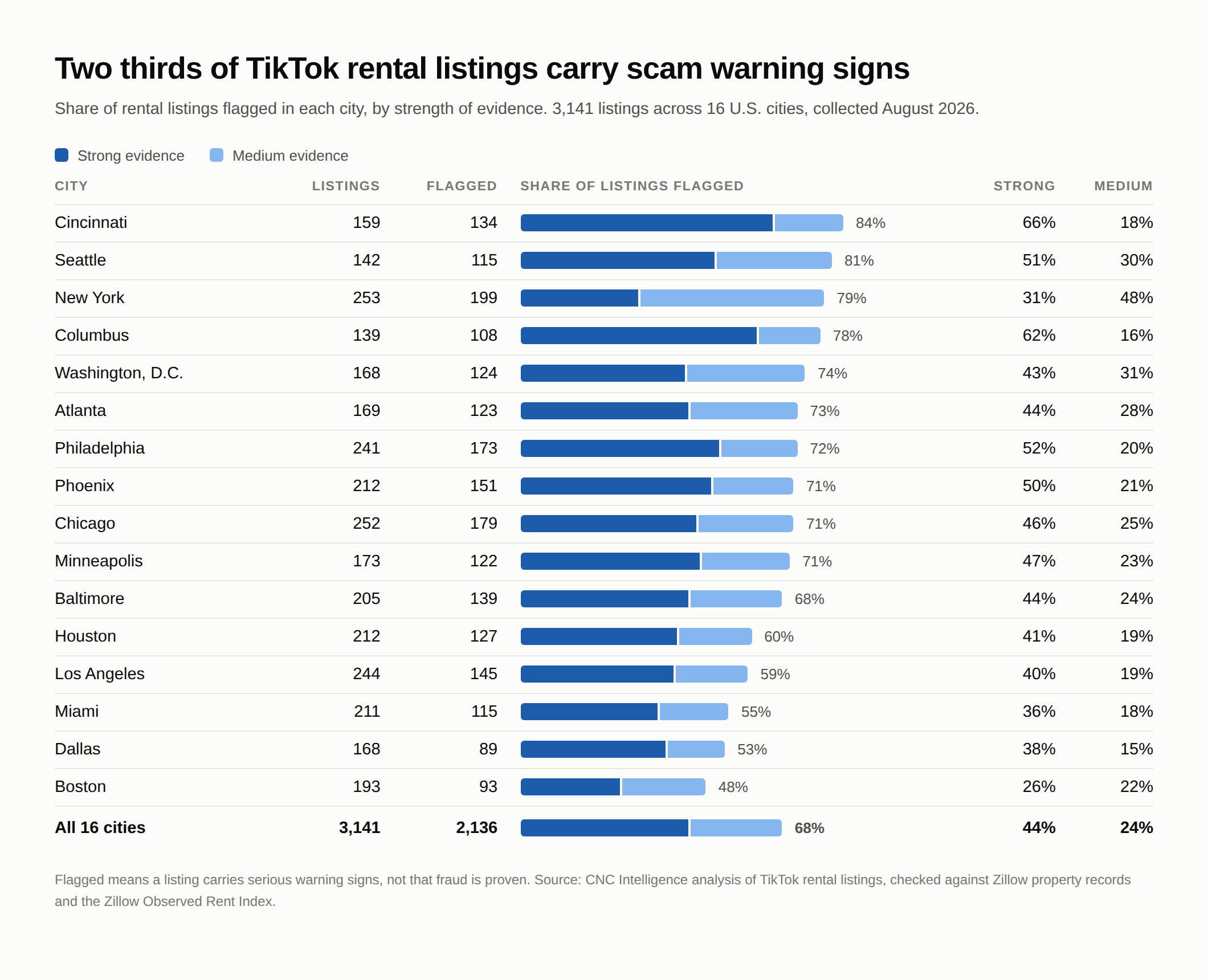
Cincinnati tops the table: 84% of the listings we collected there carried warning signs, and two-thirds carried strong ones. Seattle follows at 81%.
Below that the spread is narrow. Seven of the 16 cities sit between 68% and 74%.
New York sits second from bottom on strong signals, but that is a consequence of how little its listings give you to check. Only 21% could be matched to a property record, the lowest of any city. Combining strong and medium, New York rises to third, with 79% of its listings flagged.
Boston sits bottom at 48%, partly for the same reason. 28% of Boston’s listings fell into the “could not be checked” group, double any other city.
What a flagged listing looked like
The following are examples from our dataset. Accounts, handles and street addresses have been withheld. Posts have been anonymized.
A Los Angeles listing at 28% of the estimated rent
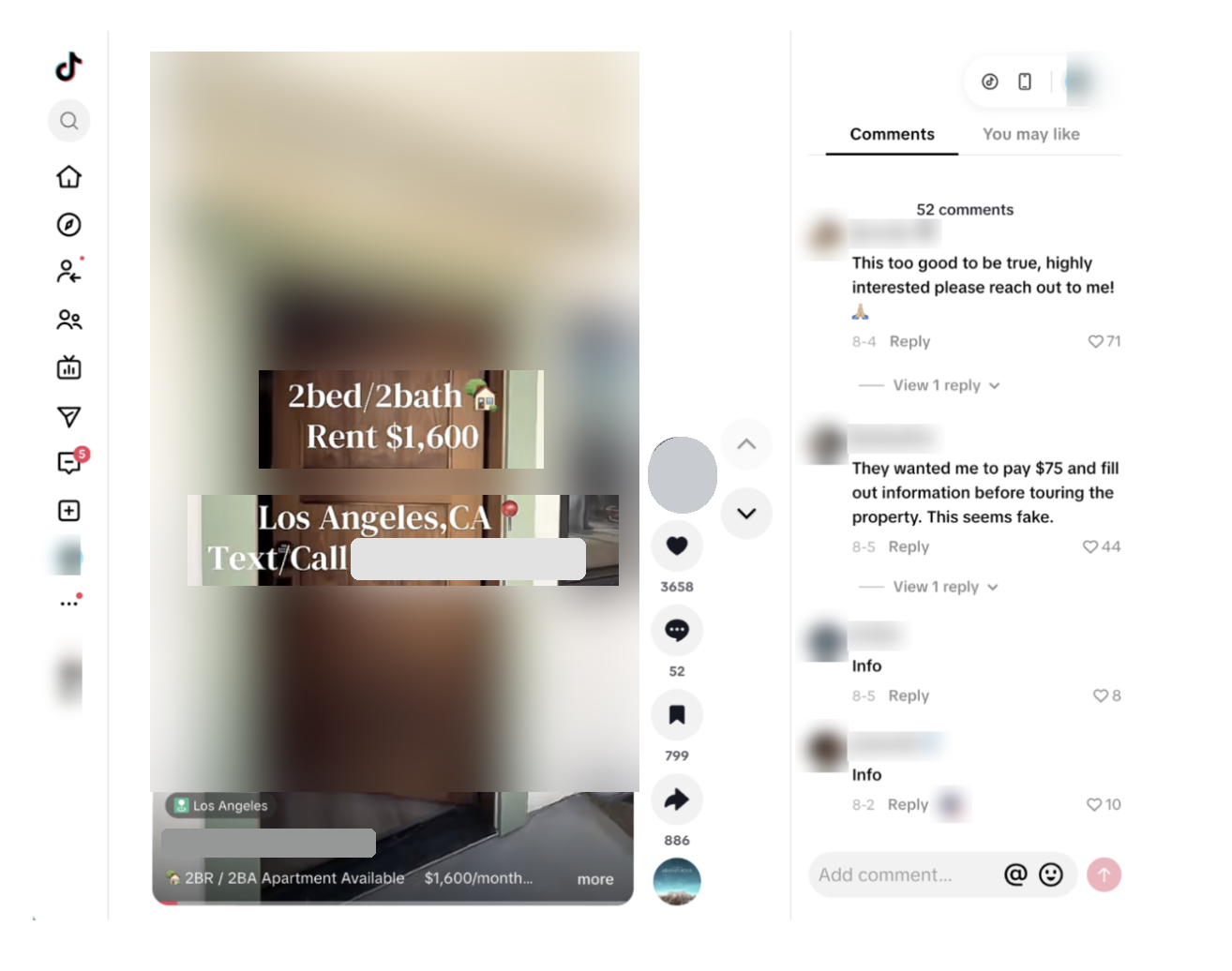
A two-bedroom advertised at $1,600 a month. The address given in the post has a Zillow rent estimate of $5,683. A commenter on the post said they had been asked to pay $75 and hand over personal details before being allowed to tour the property.
A Chicago “loft” that public records show is a six-bedroom house
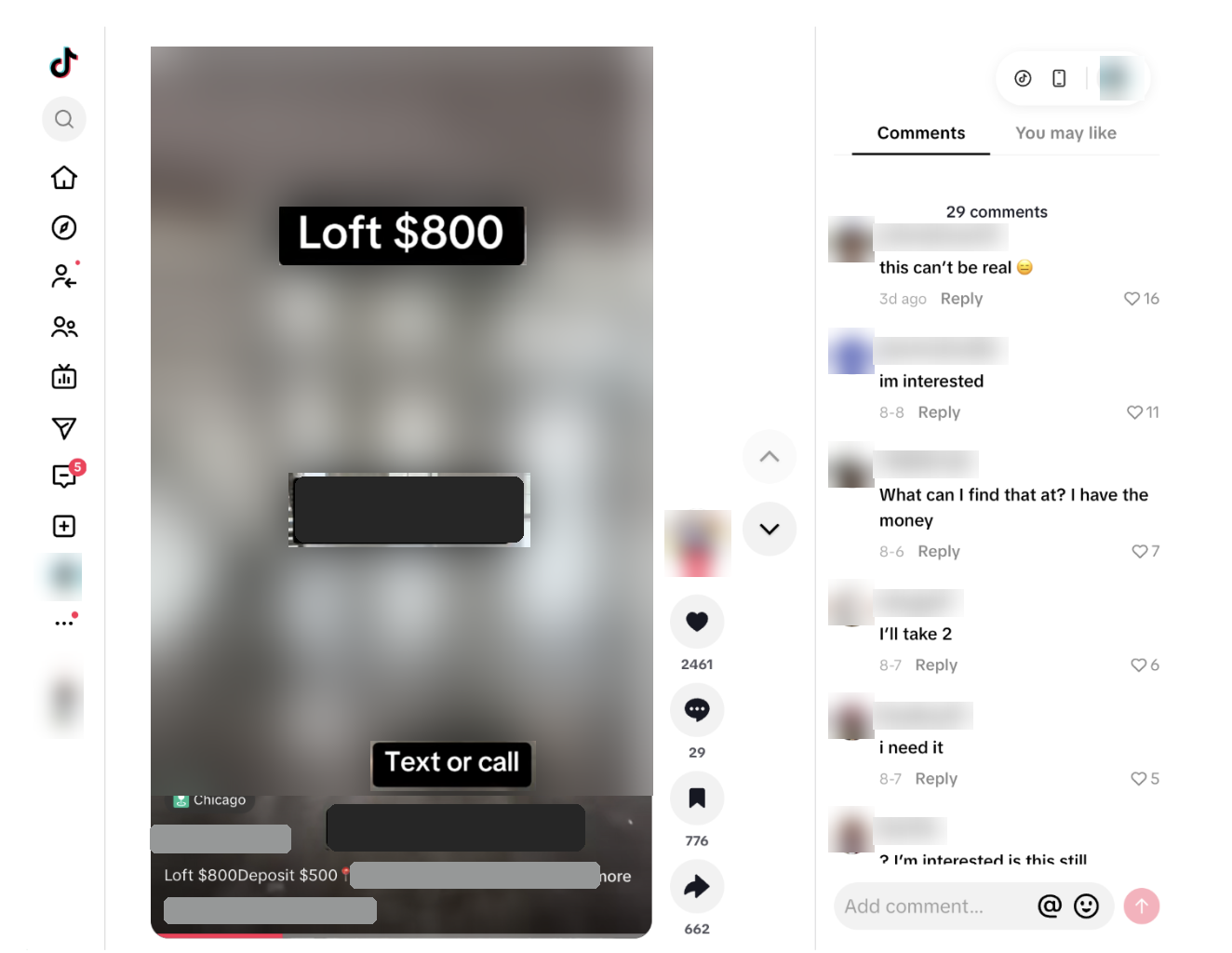
A post advertising a loft. Public records for the address in the caption show a six-bedroom single-family home that last sold in 2019 for over $2 million, and the interior shown in the video does not resemble the actual property.
One phone number, two cities.
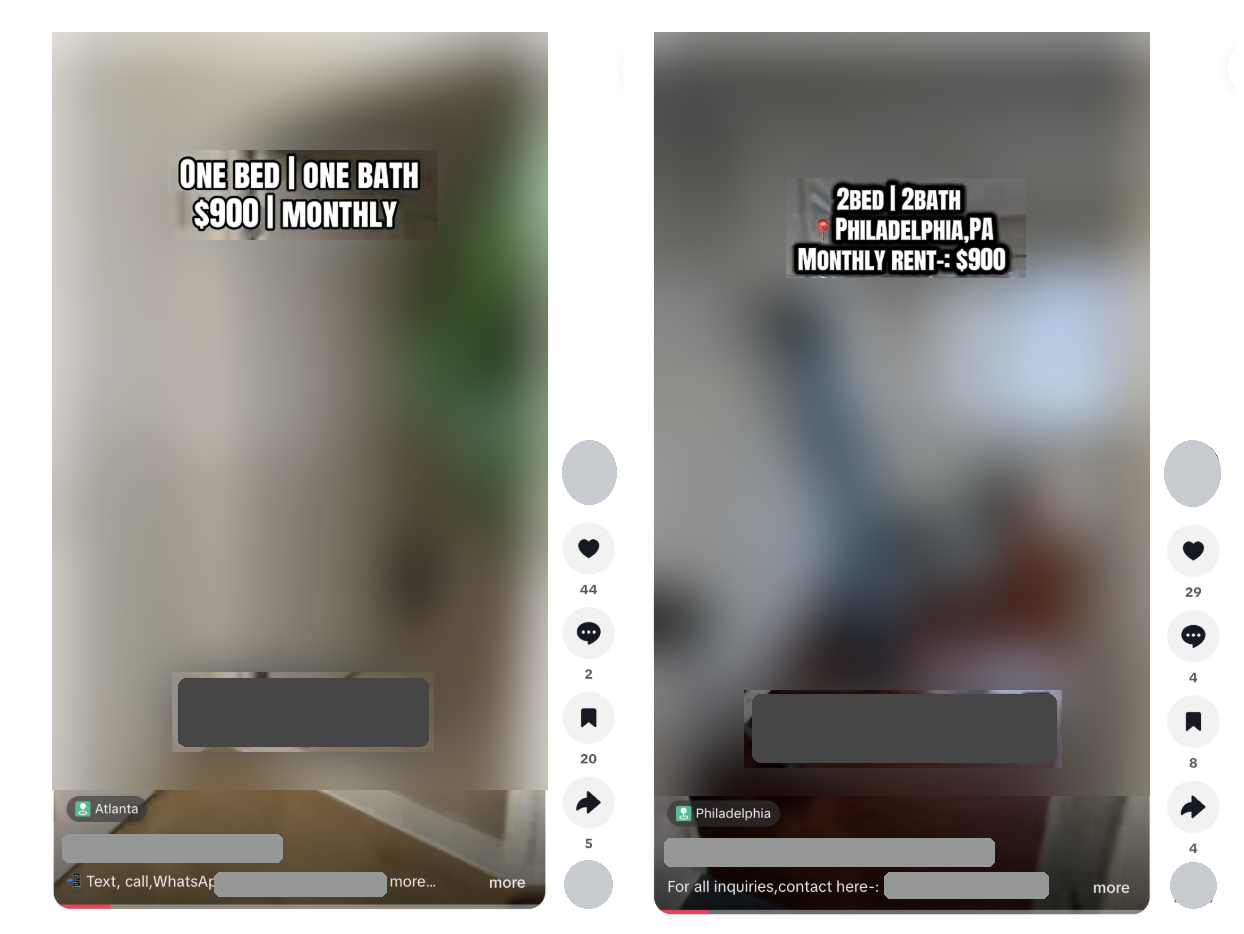
Two unrelated accounts, one advertising in Atlanta and one in Philadelphia, listed the same phone number – with an area code local to neither city.
Both advertised a rental at $900 a month, around 46% and 48% below the market rate for comparable properties. One of the two accounts was two weeks old.
What happened when we made contact
We messaged a sample of flagged accounts asking if we could view the property. Most would not engage unless we texted them on a number they provided, which is itself a warning sign.
One account did respond in the app. It was advertising a two-bedroom rental in Baltimore at $700 a month, against a Zillow rent estimate of $1,825 for the property.
When we asked about arranging a viewing, we were told we would need to complete an application form and pay a $60 “refundable” fee before we could view the property. The exchange included the following messages:
- “Our viewings are strictly by appointment. But you can drive by and take a look at the property from the outside at your convenience.”
- “Application approval is required before a showing can be scheduled.”
- “There’s also a $60 refundable application fee, which helps cover processing and holds your spot for consideration.”
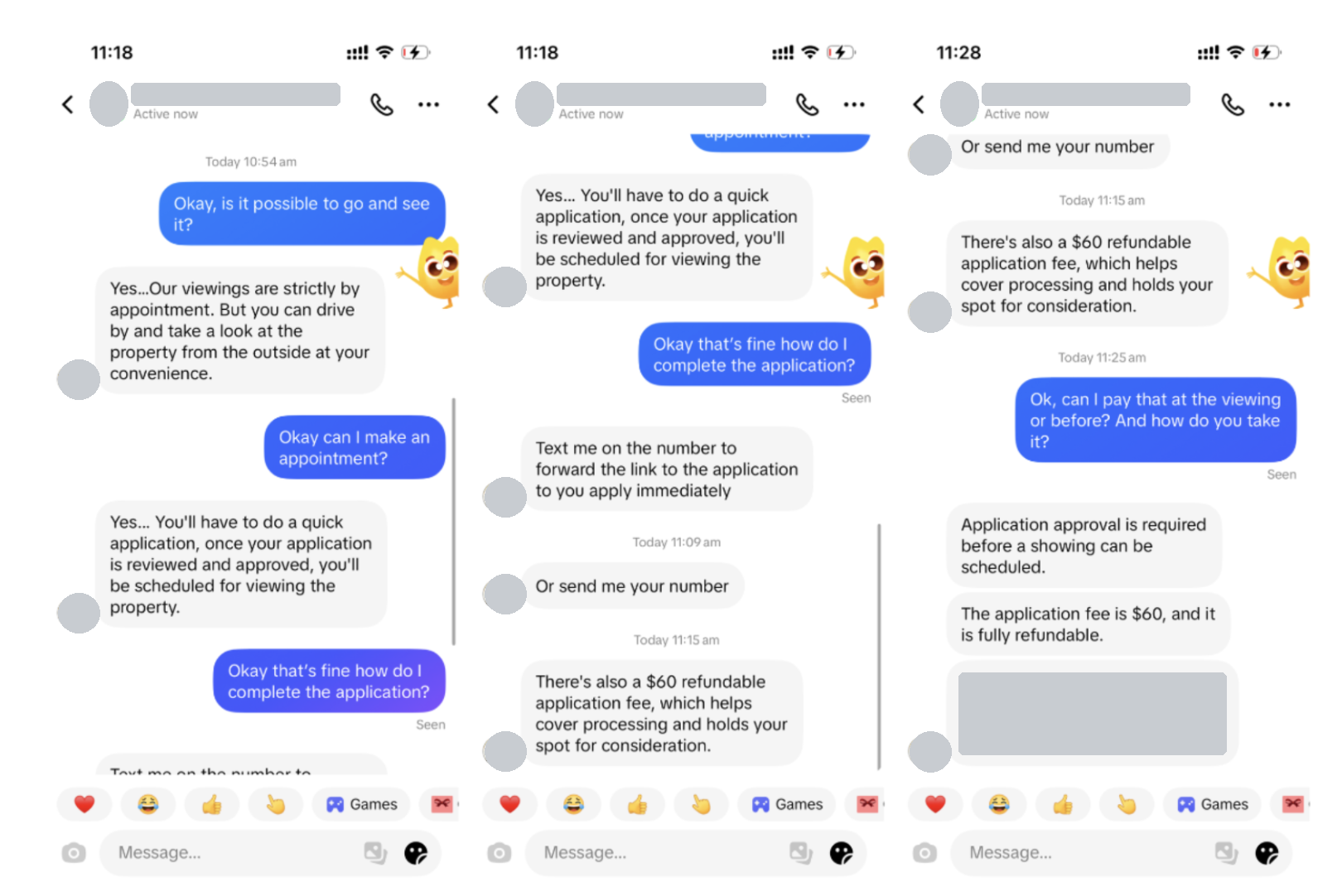
The form requested personal information including name, current address, date of birth, occupation and monthly income, as well as how quickly we could pay a security deposit. We did not complete it or make any payment.
Payment was offered via six methods: Zelle, PayPal, Apple Pay, Chime, Venmo or Cash App. Authorized payments through apps like these can be difficult to reverse.
How the scam works
Price was the common factor – most of the flagged listings advertise a rent well below the market rate for the area to lure in prospective renters.
Many listings also gave very little away. Just under half of those we reviewed, 1,407, did not name a street – only a neighborhood, a price and a phone number, which leaves a renter with little to verify.
It’s common for listings to use photos or videos from legitimate online listings, so the post itself can look very legitimate and polished.
In the exchanges we had, contact moved off TikTok quickly, and money was requested before any viewing, described as an application fee, a credit check or a holding deposit.
The application forms we were sent request enough personal information to be valuable in themselves to scammers, whether or not any payment is made. They can use the information provided in further scams, or sell it.
How to avoid a rental scam
Wherever you are searching, these checks are worth doing.
Treat a low price as a warning, not a bargain. A rent well below everything else in the area is a sign that a listing may not be real. If you are searching in a new location, ensure you have a general idea of what the prices should be.
Look the property up yourself. Search the address or building name to see whether it is listed elsewhere. Listings are frequently copied with only the price and phone number changed. If a different agent or management company appears, call them on the number from their own website, never the one you were given. You can also reverse image search any photos to see if they belong to a different listing.
Check who you’re dealing with. Look at how old any online accounts are and what else has been posted. An account with no history, advertising several properties a day, is a red flag. If the person claims to be an agent, look them up against the state’s real estate license lookup.
See the property before you pay anything. If possible, go and see the property for yourself, or send someone you trust. If you can’t view the property in person, a live video tour is also an option. Be wary of pre-recorded video walkthroughs as these can be stolen from someone else’s listing.
Methodology
In order to assess how common fake rental listings have become on TikTok, CNC Intelligence collected 3,141 rental listings across 16 popular U.S. rental cities in August 2026 and checked each against public property listings and local rent data.
In each city we searched four terms – [city] apartments, apartments for rent [city], house for rent [city], room for rent [city] – and reviewed up to 100 videos per term, keeping any post advertising a specific property for rent, posted in 2026, in the correct city.
Where a listing gave an exact address we checked it against the property record. Each asking rent was then compared against the best local benchmark available: the property’s own listed or estimated rent where we had it, otherwise a rent index for its ZIP code or neighborhood, adjusted for bedroom count.
Note: that rent benchmarks are modeled figures and carry a margin of error.
Each listing was assigned warning signals, weighted strong, medium or soft:
- Strong signals: a property that records show is listed for sale rather than rent; a property on the rental market elsewhere at 25%+ above the advertised rent; the same phone number was used by apparently unrelated accounts advertising rentals in different cities.
- Medium signals: rent 25%+ below the ZIP-level, bedroom-adjusted figure, or 50%+ below the city average; a bedroom count that differs from the property record.
- Soft signals: an out-of-area phone code; a very new account posting constantly; an unusually low deposit; a commenter questioning the listing.
A listing is flagged if it carries any strong signal, any medium signal, or three soft signals. Heavier or more numerous signals move a listing from medium to strong. Listings with too little information to assess are reported separately rather than treated as clean.
TikTok was contacted for comment prior to publication.
Sources: Rental listings were collected from TikTok. Property listing status, bedroom counts, asking rents and rent estimates are from Zillow, as is the Zillow Observed Rent Index used for area-level benchmarks. Bedroom adjustments use HUD Fair Market Rent bedroom ratios (FY2026). Rental scam loss figures are from the Federal Trade Commission.